Eliot Hudson
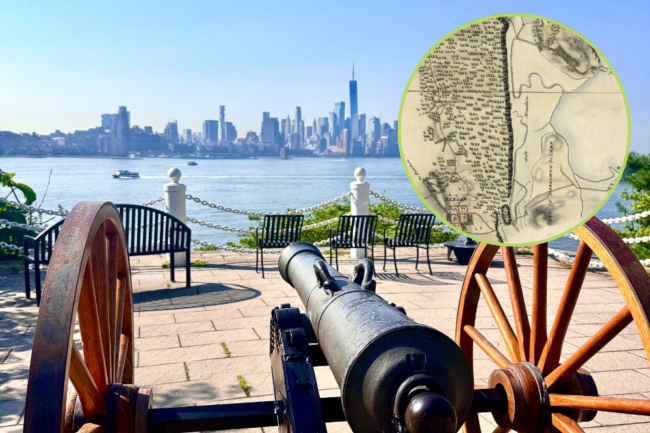
We’ve been thinking a lot about Hoboken’s history, both secret and not. Between gorgeous, architecturally significant facades and (alleged) tunnels for bootleggers during Prohibition, and the upcoming America 250 celebrations, it’s been on our minds. The Stevens Cannon is an iconic local landmark, but many people don’t know the backstory. First, her name is La Girouette, which means weathervane. She was part of a covert shipment of munitions to American rebels in 1777, and she went missing for nearly 100 years. Now, we’ve retraced her path from a clandestine arrival in America to keeping guard on the crest of the Stevens campus.
The story almost seems beyond belief, yet includes: history, war, intrigue, opera, international juggernauts ranging from Ben Franklin to Bugs Bunny, and even an Apple TV+ mini-series starring Michael Douglas. Just in time for the Fourth of July, The Hoboken Girl has pieced together the story behind this local landmark, which is older than the United States. The cannon was a key player in the fight for American independence, and it seems fitting to tell her story on the eve of the 4th of July. Read on for more about the Hoboken landmark that’s older than the United States, the Stevens cannon.
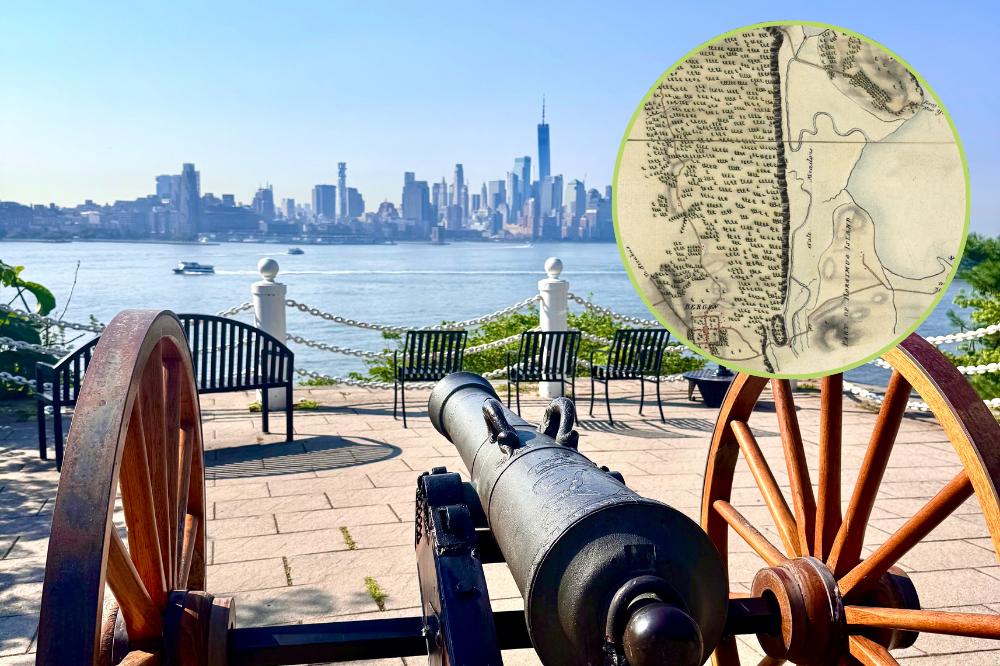
The Stevens Cannon
The myriad of commemorative cannons scattered throughout Hoboken could provision a small army: from the Public Library’s USS Maine shell (which launched the Spanish-American War) to the Portsmouth cannons in Stevens Park (which annexed San Francisco, acquiring the city for the United States). Yet the cannon which resides atop Hoboken’s highest point upon Stevens Campus not only predates the United States, it helped forge the United States.
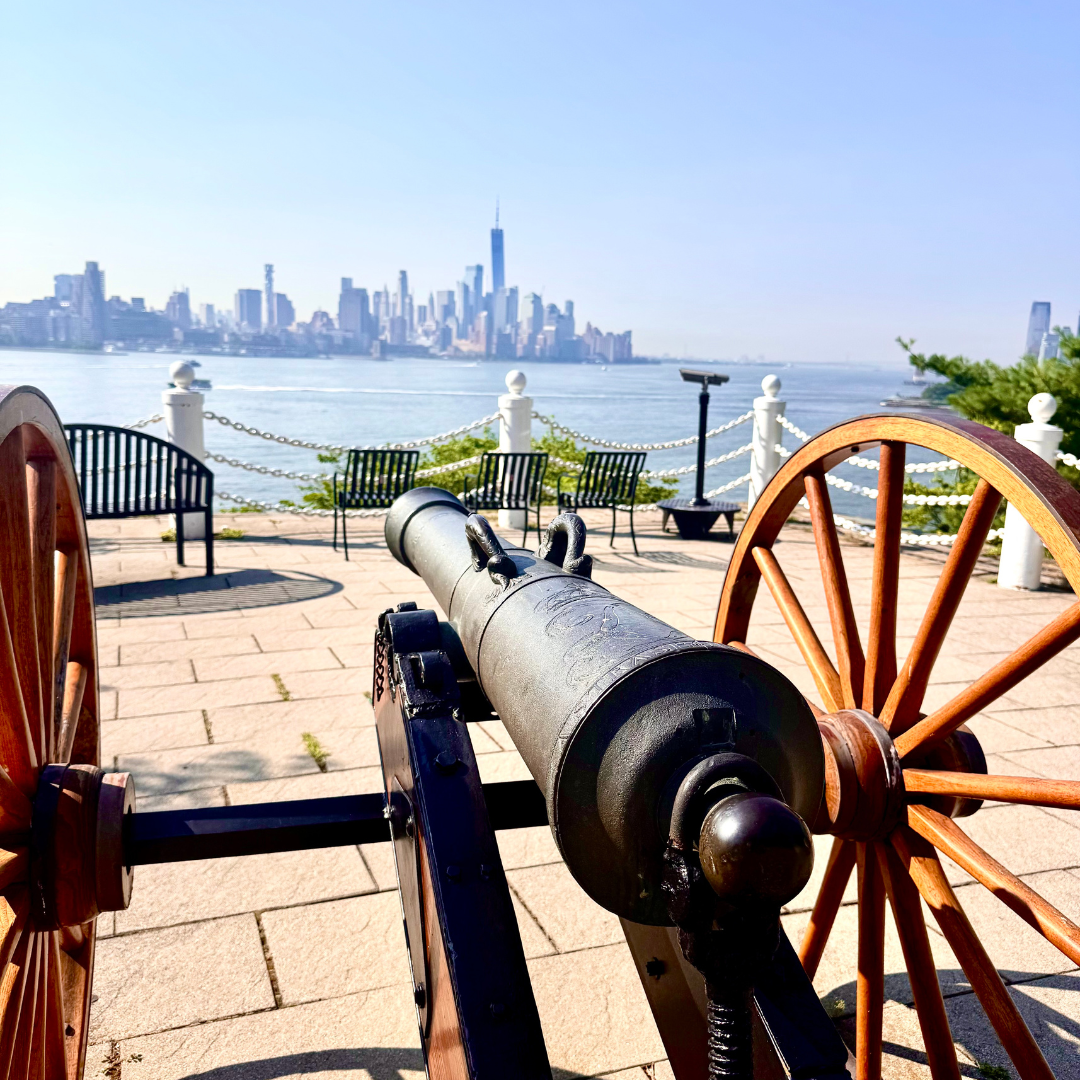


When excavators working on the Colonnade Hotel (at the site of today’s Maxwell Buildings) first uncovered the cannon in 1888, little did they know it had arrived upon the shores of America on April 20, 1777, in a covert mission to rescue the Patriots in their hour of need at the dawn of the Revolutionary War.
Yet in 1888, Hobokenites seemed just as puzzled about where the cannon came from as about what to do with it. After a brief stint at Hoboken’s Turtle Club, shellshocked and tired of terrapin, the cannon aimed higher and ascended to Hoboken’s summit at Castle Stevens, where it outlived Stevens’ castle, yet still remained a mystery. Its long-term residency at Stevens Campus explains how the piece of antique artillery became known to locals as the Stevens Cannon.

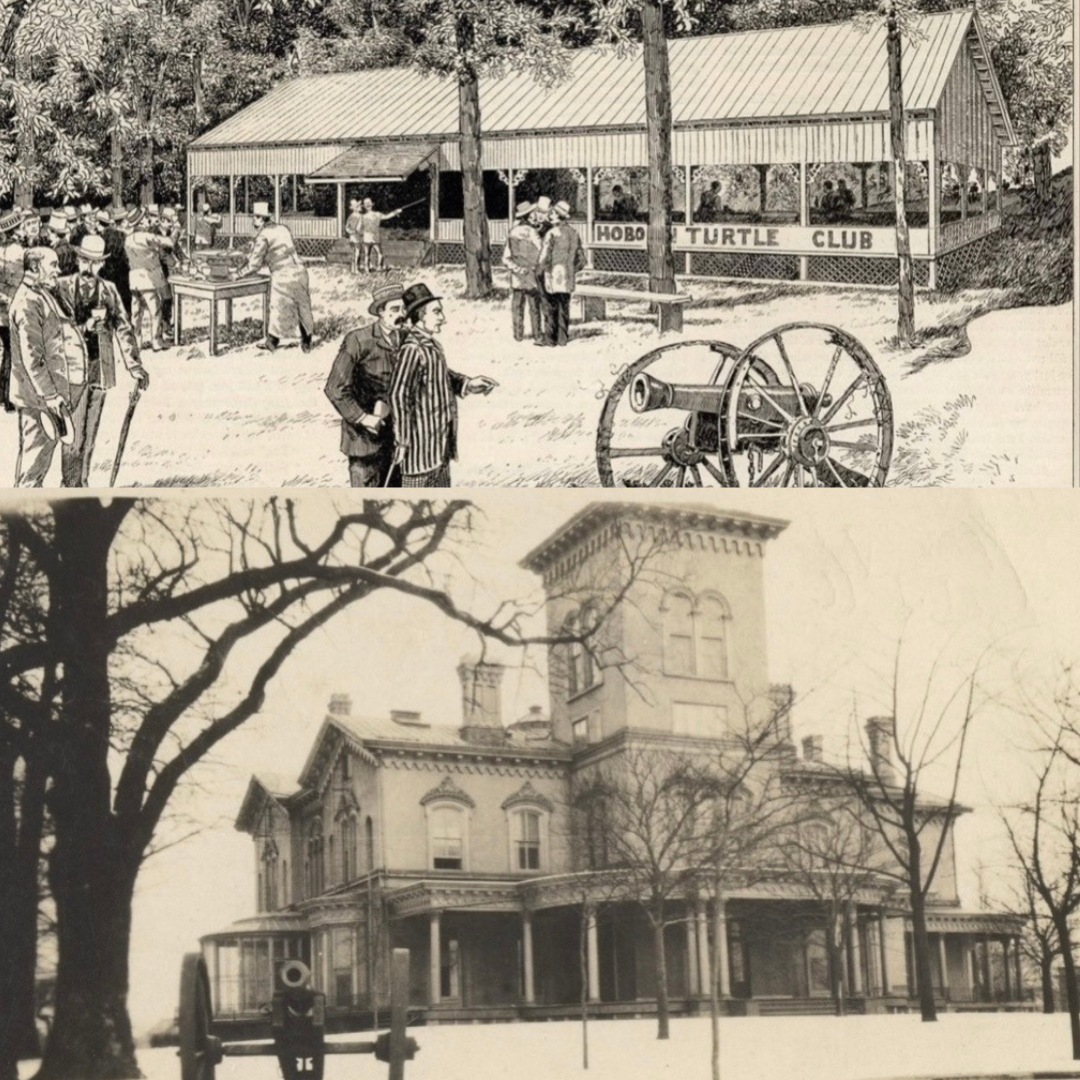
Cannon at Hoboken’s Turtle Club & Castle Stevens (Credit: Hoboken Historical Museum & Stevens Institute of Technology Archives)
When students weren’t including the cannon as a prop in 1940s plays, stealing the cannon as a prank in 1968, or playfully sacking New York City by ferrying the cannon to and from Manhattan, they may have wondered about its 1761 date, pondered the strange name upon the muzzle, or daydreamed about how on earth an 18th-century European cannon wound up in Hoboken to begin with?
Clue 1: The Plot + The Players
The pact that delivered the enigmatic cannon to Hoboken began as a clandestine international gun-smuggling ring under circumstances that some historians have called America’s First Black Ops.
When Colonial Americans began to rebel under British rule, it seized the attention and intrigue of the French. The same French who’d just suffered humiliation and financial ruin after defeat in the 7 Years’ War, surrendering nearly their entire worldwide empire to King George, exalting Great Britain as the sole, hegemonic, global superpower. Still licking their merlot-soaked wounds, the French could hardly muster funds, provisions, or morale to mount a follow-up military offensive, and that’s when playwright Pierre-Augustin Caron de Beaumarchais stepped onto the stage. Pierre’s other claim to fame: he introduced the character Figaro in his plays The Barber of Seville and The Marriage of Figaro, which ties this whole legend to our favorite Saturday morning cartoons, Bugs Bunny + Tom & Jerry, both of whom performed selections from Figaro-fan-fiction-follow-up operas by Mozart and Rossini.
A bleeding-heart Romantic, a condition which plagues many artists, Pierre empathized with the underdog virtues and common-man philosophies promoted by the Patriot plight. During one serendipitous dinner party, a diplomat from Massachusetts casually expressed a pie-in-the-sky dream that some foreign power (hostile to King George) might miraculously rescue the Patriots from British tyranny.
 Pierre-Augustin Caron de Beaumarchais
Pierre began petitioning King Louis of France to aid the Patriots, not only for righteousness’ sake, but to spite the British. Initially hesitant, the counterpoint melodies of revenge and reprisal persuaded Louis to consider Pierre’s proposal, optically allowing the French King to remain far from the conflict, bound to his ship’s mast for diplomatic deniability.
Pierre devised a clever plan, formulating a shell corporation, Roderigue Hortalez and Company, which laundered funds and concealed any involvement of the French Government. Within two months, King Louis had convinced his cousin, the King of Spain, to enter the plot, which resulted in over 1,000 barrels of gunpowder, 18,000 muskets, 9,000 grenades, 300 bombs, 153 cannons, 20,000 cannon balls, along with additional tons of iron balls, lead balls, tents, canvases, wool-bales, grape-shot, pickaxes, and more to the shores of the rebellious Colonies between April and June of 1777.
Read more: The History of The Plank Road Boom in New Jersey
All the while, Pierre coordinated directly with Ben Franklin through a surreptitious council literally called The Committee of Secret Correspondence, formed in November of 1775, to bypass Congress because, according to Ben: We find, by fatal experience, that Congress consists of too many members to keep secrets.
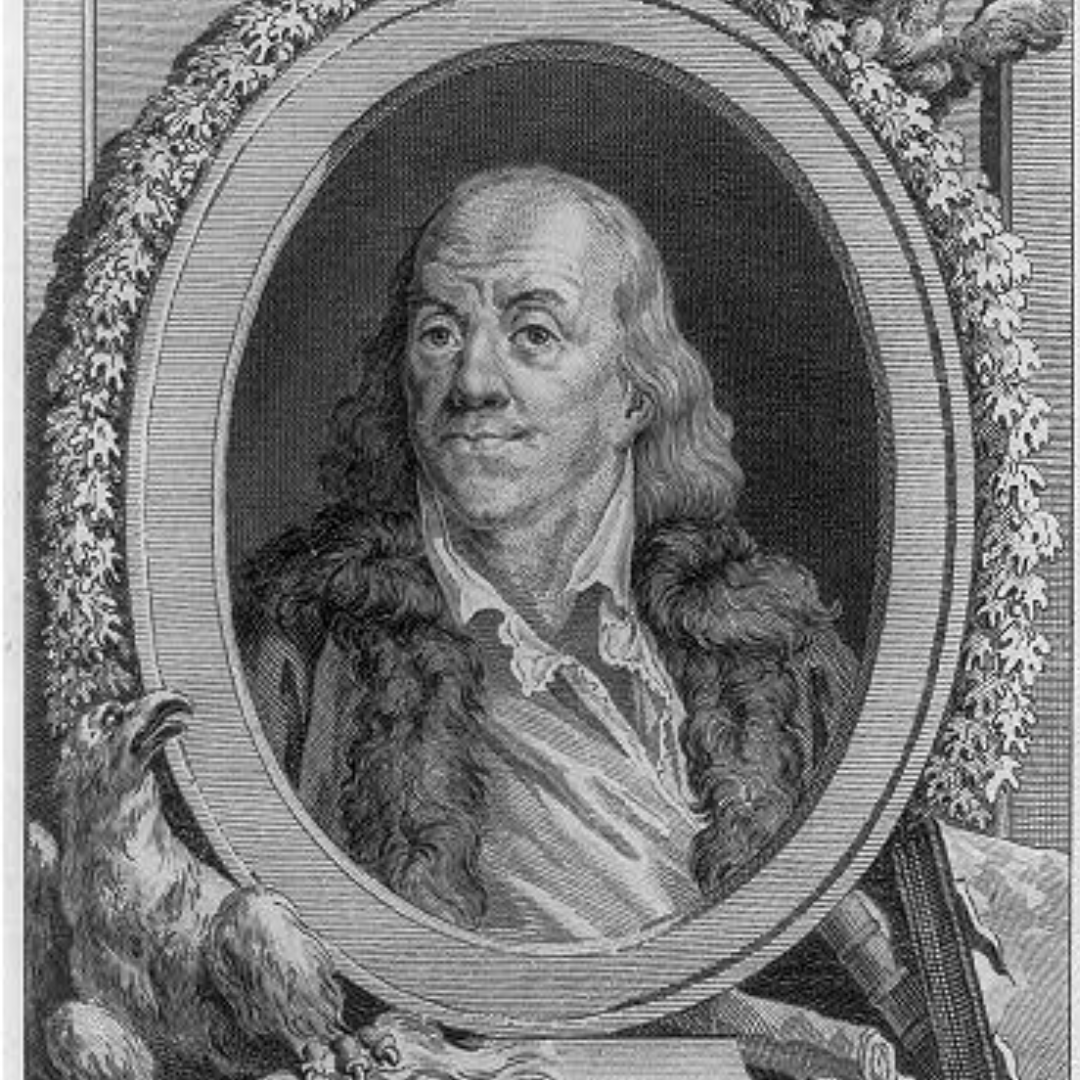 An engraving of Benjamin Franklin circa 1782. Credit: Library of Congress
As the ragtag group of rabble-rousers clumsily fumbled over how to assemble the disparate pieces of America into a cohesive governing body, the Committee of Secret Correspondence acted as a hybrid of America’s first-ever Secret Intelligence Service entangled with a proto Foreign Affairs Office, all headed by Benjamin Franklin. This cloak-in-cannon operation became the focal point of AppleTV+’s miniseries Franklin, in which Michael Douglas dons a powdered wig and a beaver-fur cap to portray Big Ben.
Clue #2: The Cache of Cannons
The Stevens Cannon was one of 153 total cannons that were sent to the American rebels by the French. On April 20, 1777, 31 sister-cannons arrived at Portsmouth, New Hampshire, onboard the first large ship to reach American shores, L’Amphitrite, named for the Queen of the Ocean, and wife of Poseidon: Amphitrite.
Manufactured in Strasbourg, Sweden, in 1761 with exceptional craftsmanship and embellished artistry (such as exotic pisces-handles), these rare cannons spangle the United States with each one bearing a singular, distinguishing name emblazoned upon the barrel to epitomize each firearm. The Stevens’ Cannon flaunts the name La Girouette, meaning Weathervane in French, for she can pivot like the breeze and blow harder than the wind.
These cannons were notable for several reasons: first, they are individually named, making it (theoretically) easier to track their movements. Second, the canons took a 4-pound munition, which was the preferred size of the French armed forces. Third, the cannons were significant to America’s success in the war, and the cannons are frequently featured in prime positions in paintings and illustrations of the war. And finally, they are called French, since that’s who supplied the cannons to the Americans, even though the cannons were manufactured in Sweden.
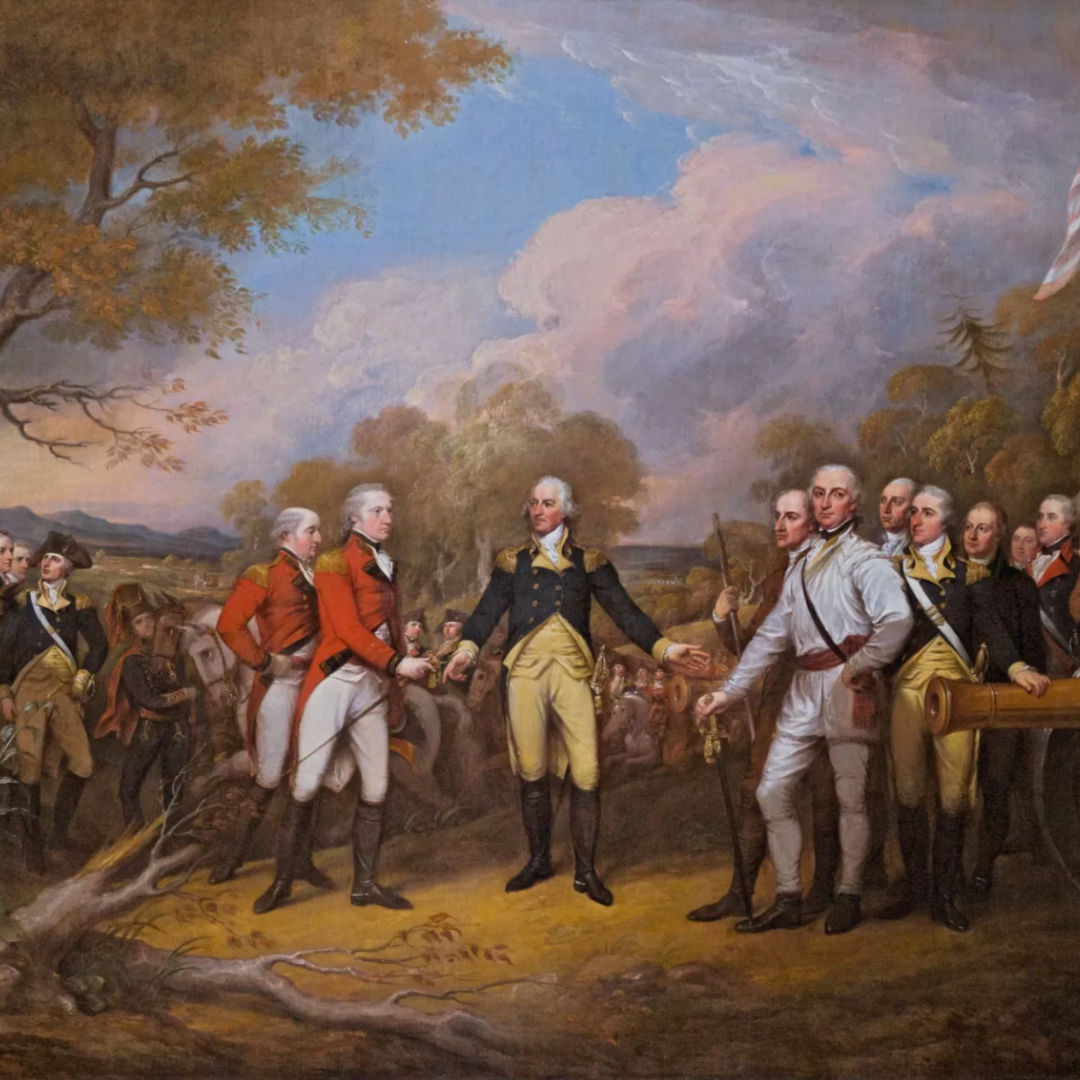 Revolutionary Paintings by John Trumbull, Surrender of General Burgoyne. Credit: Architect of the Capitol
These guns were a critical part of the Americans’ success during the Revolution. The Painter of the Revolution, John Trumbull, includes a sister Strasbourg cannon in one of the four Revolutionary War scenes ornamenting the U.S. Capitol Rotunda in the Surrender of General Burgoyne, depicting General Horatio Gates’ triumph at Saratoga on October 17, 1777, five months after the cannon’s arrival upon L’Amphitrite, illustrating their critical impact on the War and making the cannons just important actors in the war as the Patriots portrayed in Trumbull’s painting. The pisces-handles painted by Trumbull perfectly match those festooning the Stevens’ Cannon.
Clue #3: The Setting
Hoboken became a part of the Revolution before the Revolution even commenced on July 4th. As tensions mounted between the Colonists and the Crown, Patriots began to muster their own institutions for protection, convening the more permanent Second Continental Congress on May 10, 1775, and the Continental Army on June 14 of that year. Soon, Major General Lord Stirling commanded New York’s Provincial Congress to install Colonial Guards in Hoboken, a full seven months before the Declaration of Independence on July 4, 1776. Therefore, Hoboken was Revolutionary even before the Revolution.
Interestingly, even the American Revolution could not stymie Hoboken’s Real Estate Rental Market, which proved harder to subdue than Colonial rabble-rousers, as the land-owner, William Bayard, listed his Hoboken property to let on the brink of war. Without Zillow, Bayard was forced to advertise his property in The New York Gazette and the Weekly Mercury, touting a garden spot scarcely to be equalled and a very fine Asparagus bed.
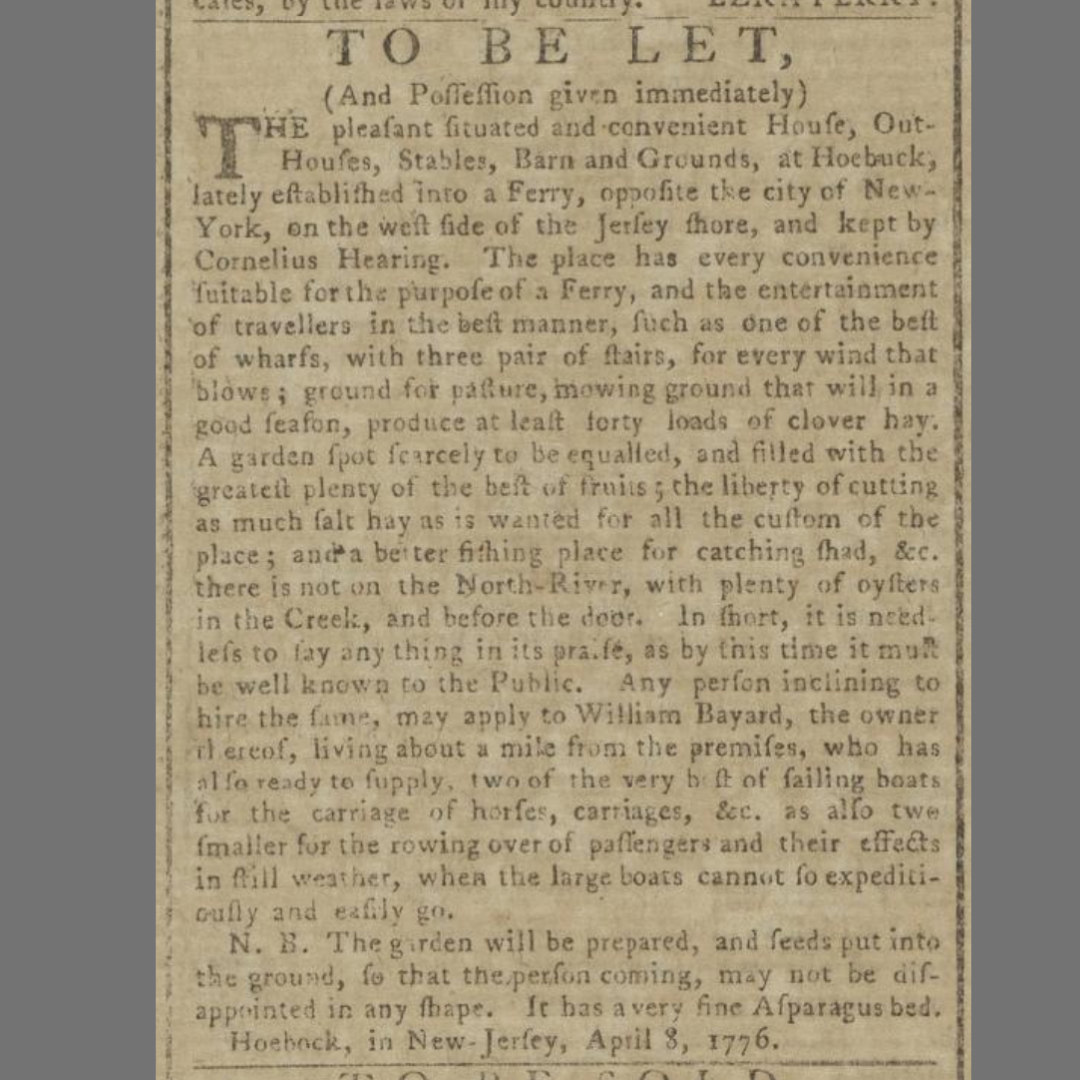 The New York Gazette, May 20, 1776, showing Bayard’s ‘to let’ ad. Image credit: Library of Congress.
Little could Bayard imagine that his very fine Asparagus bed would soon become the front lines of the American Revolution. For the remainder of the war, though formally under British control, Hoboken and the surrounding landscape became a chaotic No Man’s Land of contest and conquest. Both Patriot and Loyalist foraging parties scoured the land, desperate for food, cattle, ammunition, and retribution, provoking numerous skirmishes, raids, and bloodletting at such a magnitude that it became a subset of the American Revolution designated the Forage War.
1,500 British, Hessian, and Regional Troops fortified Bergen County (encompassing today’s Hudson County, which would not come into formation until 1840), launching sentinels, raids, and retaliations across the countryside from their stronghold, Paulus Hook Fort, in Jersey City.
See more: Famous ‘First’ Occurrences That Happened in Bergen County, New Jersey
Because of the ceaseless assaults devastating his Hoboken homestead, newspapers described Col. Bayard as one of the greatest sufferers in America, and in February of 1779, the British allotted him 250 Rank & File soldiers and two 4-Pounder cannons loaned by the Royal Artillery to protect his Hoboken estate. This is the final attested account of 4-pound cannons arriving in Hoboken after a corroborated acquisition of cannons aligning with the arrival of the Pierre’s 4-pounders. This is the best documented evidence placing the Stevens’ Cannon in Hoboken.
When on August 30, 1780, Patriots raided Bayard’s estate, setting fire to his house, barns, croplands, and orchards in a blaze which raged for 2 days, no reports or indications of Patriots’ recapturing 4-pound cannons surfaced in any recorded documentation. Certainly, had the Patriots seized the cannons, one would assume that a written record would boast of the achievement.
Even General George Washington recognized Hoboken’s importance, ordering “a party of the trustiest” Patriots to fortify our hometown, in a November 1780 letter.
The Aftermath
After eight years of bloodshed, the American Revolution staggered to an end, and peace finally prevailed upon Hoboken’s ravaged ground.
Pierre spent his entire life’s fortune assisting and rescuing the Patriot cause. Yet, the paradoxically flamboyant and covert mastermind who bestowed the Stevens’ Cannon to Hoboken never saw a penny-farthing of restitution from the newly forged bastion of Freedom he worked so tirelessly to liberate.
In the wake of British defeat, Patriots discovered the disgraced Col. William Bayard “[sic] in the Disguise and Habbit of a slave.” He soon acquired the epithet Weeping Billy when Patriots reported him bawling aboard the HMS Phoenix in exile to England, where he remained for the rest of his life.
Yet, more recent scholarship has reconsidered Weeping Billy’s alliances and political commitments, suggesting a more savvy strategy of skillfully hedging bets, sacrificing his own reputation and livelihood in America for that of his son, William Bayard Jr., who remained in the United States while the father and son maintained a family trading enterprise effectively exerting dual-citizenships in a mutually beneficial and lucrative transatlantic partnership, allowing their descendants to marry into the Stevens family, and ultimately reacquire the family’s Hoboken lands forfeited after the Revolutionary War.
The newly formed United States Government confiscated and auctioned off Col. William Bayard’s Hoboken estate, which an American Revolutionary War veteran purchased by the name of Col. John Stevens, who laid out the street grid that still shapes Hoboken today. Col. Stevens and his descendants proceeded to make Hoboken the Cradle of Yachting in America, the Birthplace of the American Railroad, and establish the esteemed Stevens Institute of Technology.
Stevens Institute of Technology’s Head of Archives and Special Collections, Leah Loscutoff, sums up the institute’s pride in preserving such a unique heirloom of the American Revolution: “It is remarkable to learn more about the history of the cannon on Castle Point as we celebrate our 250th anniversary. I was fascinated to discover that this Revolutionary War relic survived a high-stakes covert operation before being unearthed by the Stevens family in the 19th century. For decades, the cannon has stood as an iconic symbol on our campus and serves as a powerful reminder of the risks taken to secure American independence on the very land that helped shape a new nation.”
Today Pierre’s Cannon, La Girouette, remains on display atop a precipice high above the Hudson River, upon land which it has both besieged and safeguarded. After a 2015 refurbishment, the cannon remains one of the most popular on-campus spots for a photo op.
An artifact of America’s first secret intelligence committee (covertly negotiated between the world’s most visible dignitaries and celebrities), the enigmatic cannon once concealed beneath Hobokenite’s feet has patiently waited 136 years to reveal her story.
Follow @thehobokengirl on Instagram + TikTok for the latest Hoboken and Jersey City updates, sign up for our weekly newsletter here that shares everything you missed each week, and check out our events calendar, which has over 100+ events weekly to peruse.