The Hoboken Girl Team
Editor’s note: This is a guest article shared by former Hoboken resident, Al Ferriulo.
Hoboken is known for a lot of things: brownstones, waterfront views, Frank Sinatra, and a bar scene that’s always been a draw. But what many don’t know about are the underground tunnels tied to Hoboken’s waterfront, its German beer hall days, and the Prohibition-era bootlegging scene. Read on for more about Hoboken’s past through one resident’s recollection.
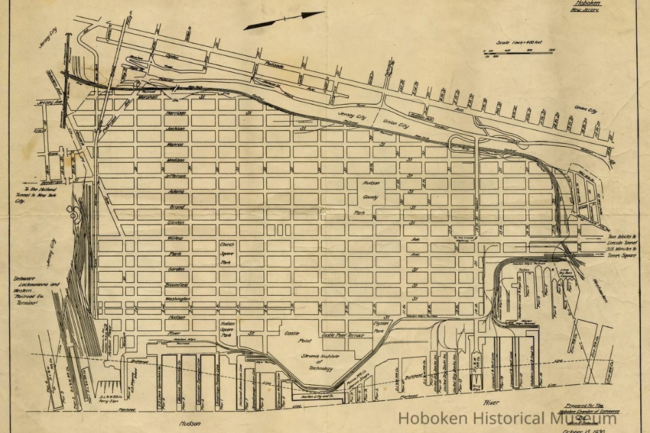
A map of Hoboken, circa 1930. Image courtesy of the Hoboken Historical Museum.
Firsthand Experience
I had always heard stories about underground tunnels in Hoboken. Then, at one point, I saw one for myself.
Back in the 1970s, Vinnie Logan, who ran the Grand Hotel, took me down into the basement and showed me a tunnel that ran toward the river. It had been cut off after Marine View Plaza was built, but the passage was still there. There were also bowling alleys down there – apparently, the old Germans liked to bowl.


That one visit sent me down a rabbit hole. I started doing a little research and found that Hoboken’s underground tunnel stories are part history, part local memory, and part waterfront legend.
Hoboken’s Prohibition-Era Underground
During Prohibition, from 1920 to 1933, Hoboken’s location made it a natural hub for bootlegging. The city’s compact waterfront, busy docks, ferry connections, and dense bar-and-hotel district created the perfect setup for moving liquor quietly. Along the River Street and Hudson Street corridor, especially near 3rd Street, liquor could be offloaded from ships, barges, or small boats along the Hudson River and moved discreetly inland.

Read More: This Hoboken Resident is Celebrating Her 106th Birthday
In many cases, these passageways were not massive, engineered tunnels. They were more practical than dramatic: coal chutes, utility passages, basement connections, and short routes from river-adjacent buildings to nearby docks. Some were likely part of older 19th- and early 20th-century infrastructure that was later repurposed during Prohibition. Others may have been adapted specifically to help move crates of liquor out of sight. Much of what we know today comes from oral histories, local accounts, and occasional rediscoveries during renovations.
The Grand Hotel
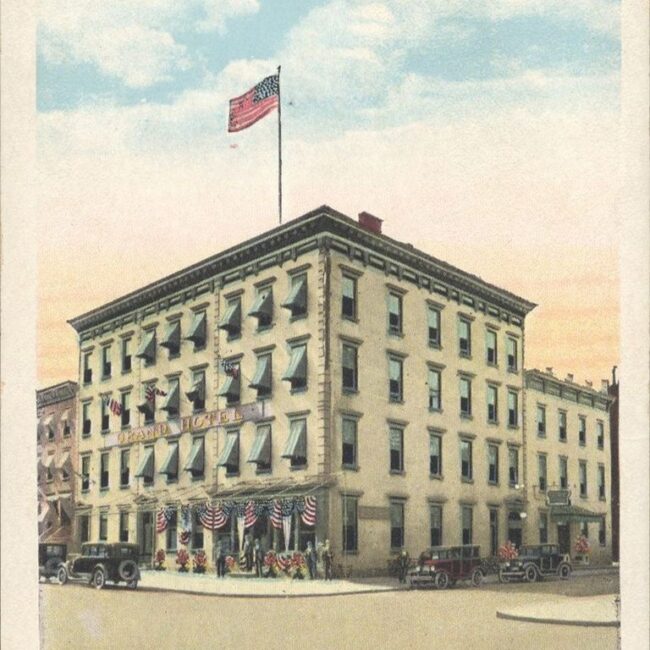
A postcard of Hoboken’s Grand Hotel. Image courtesy of the Hoboken Historical Museum.
One of the best-known local examples is the Grand Hotel, which was located on 3rd Street and the Hudson / River Street area. The Grand Hotel was part of Hoboken’s old waterfront hotel and saloon scene, catering to seamen, travelers, workers, and locals. According to local accounts, the hotel had a basement access that connected to the river, making it possible to move goods and, during Prohibition, allegedly liquor, away from the docks and into storage without much attention.
The tunnel I personally saw in the 1970s was in the basement of the Grand Hotel. By that time, the passage had been cut off due to later waterfront development, including the construction of Marine View Plaza. Still, the remaining section offered a glimpse into the city’s hidden infrastructure and the stories that have surrounded it for decades.
View this post on Instagram
The basement also had bowling alleys, which speaks to another part of Hoboken’s history: its German-American community and the beer-garden culture that shaped much of the waterfront social scene.
Meyer’s Hotel
Another major name connected to this lore is Meyer’s Hotel, sometimes spelled Meyers or Myers, which was located near Hudson Street and 3rd Street. Meyer’s was one of Hoboken’s famous old beer-front establishments, a large hotel and saloon known for its lager, imported beers, and lively atmosphere. In its day, it was considered one of the city’s major gathering places, especially within the German-American community.
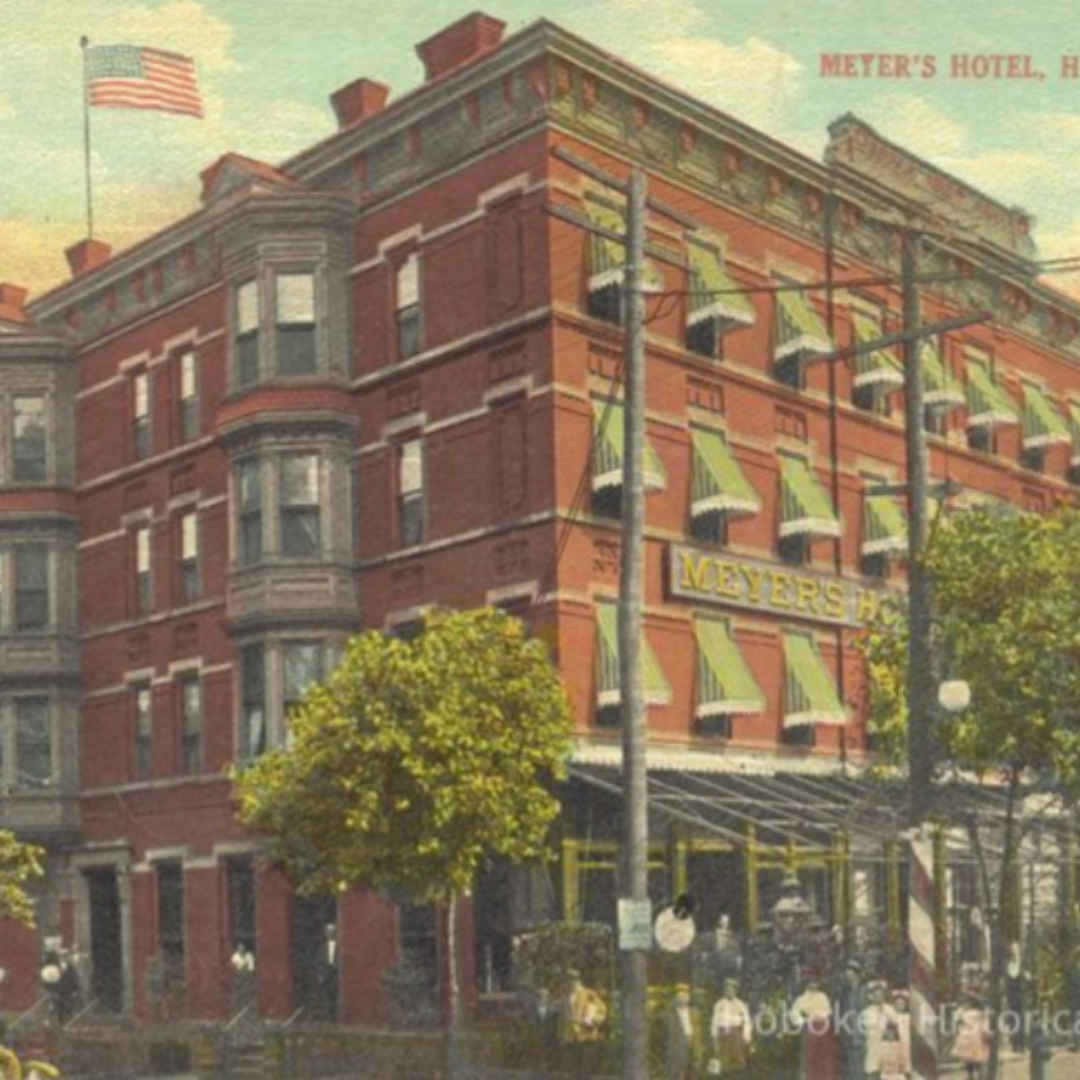 A 1916 postcard of Meyer’s Hotel in Hoboken. Image courtesy of the Hoboken Historical Museum.
During Prohibition, Meyer’s was rumored to have basement access or underground connections that could have been used for bootlegging. In 1929, federal agents raided and padlocked the establishment under the Volstead Act, shutting it down for a year. The building was later demolished around 1969, but its location places it right in the heart of the same waterfront district where these tunnel stories continue to surface.
Weber’s Germania
Weber’s Germania, also known as Weber’s Germania Hall, Garden, or Theatre, was another fixture of Hoboken’s German social and beer-hall scene. Located around 68–70 Hudson Street, Weber’s Germania hosted balls, performances, picnics, and social events tied to the city’s large German-immigrant population. These establishments were part of a broader “Kleindeutschland” culture of singing societies, beer gardens, and community halls.
Like other waterfront buildings from this era, Weber’s Germania had basement and garden-level features that locals have associated with underground access and later bootlegging activity. Whether these were formal tunnels, old utility routes, or adapted coal passages, they fit into the same pattern: riverfront buildings with hidden or semi-hidden ways to move goods in and out.
How the Tunnels Likely Worked
The word “tunnel” can make people imagine long, dramatic underground routes stretching across the city. In Hoboken’s case, the reality was likely more practical and improvised. Many of these passages were probably short connections between basements, docks, alleys, and neighboring buildings. Coal chutes and delivery passages were common in older buildings, especially in a working waterfront city.
During Prohibition, those same routes could be used to move liquor discreetly. In some cases, there may have been building-to-building connections along the bar and hotel district. In others, it may have been as simple as a hidden basement route from the riverside of a property into storage. That practicality is what makes the stories believable – these weren’t grand underground engineering projects like the Hudson Tubes, but instead hidden access points used by people who knew the waterfront, knew the buildings, and knew how to stay out of sight.
Why Hoboken?
Hoboken had all the right ingredients for bootlegging: a working waterfront, proximity to New York City, ferries, terminals, docks, hotels, saloons, and a culture that had long embraced beer halls and social drinking. Before Prohibition, Hoboken’s German-American community helped shape the city’s beer-garden and saloon culture. When Prohibition arrived, that existing infrastructure did not simply disappear. In many places, it went underground, sometimes quite literally.
The waterfront’s density also mattered. Hotels, bars, storage areas, and docks were all close together. That made it easier to move goods quickly and discreetly, especially in the River Street and Hudson Street area.
Other Resident Recollections
Valerie Hufnagel
“At the NE corner of 1st and Hudson St. about 30 years ago the sidewalk collapsed, and there were empty caverns of beautiful brickwork below the ground. I used to take care of 5 Marine View back then, so I was on site when it happened.”
Robert T. Brown
“I worked as a contractor in the 70’s and 80’s in the basement of the Hotel Victor and saw the tunnels blocked off in a few directions under the hotel, and there was a big room under Hudson St. that was a speakeasy with many booths covered in dust and cobwebs that looked like they were made of top-shelf material.”
Brian McCloskey
“I worked on Newark St., where Clam Broth house was after it closed; the entire block had connecting basements, which I believe led to the docks for bootlegging or possible Underground Railroad.”
Kurt Wallach
“I was in the basement of Hotel Victor one time. There was evidence of their tunnel, but blocked off.”
Maria Benedetto
“My grandfather told me a story of seeing FDR in Hoboken on Hudson Place, and he said he was raised up from underground on some type of lift, in his car. I wish I could remember more details.”
Polly Hans ( Jim Hans’ daughter)
“This large mirror was recovered by my parents from a sub-level area in the Meyers Hotel in the late 60s (perhaps the speakeasy you describe). When found, it was covered in dust, and someone had written in the dust with their finger ‘good luck to whoever gets this out of here’.”
Terrence Scott
“Kenny Rivera, who owned the Hotel Victor, showed me the hidden rooms in the basement- they were under the sidewalks and were very well built. He said they were built to be used as “wire rooms,” a safe place to conduct certain businesses.”
Kevin Barry McHugh
“I believe there’s a tunnel that runs under Washington Street to this day. A friend used to own a store on Second and Washington, and in the basement, if you walk towards the front, you would eventually come to a space that was under the street, and I’m pretty sure it ran further up Washington Street; stores may have to pay the city a fee for using that space. It’s usually referred to as a sidewalk vault, but this was under the street.”
See More: Bergen County History: The Oldest Homes Still Standing Today
Follow @thehobokengirl on Instagram + TikTok for the latest Hoboken and Jersey City updates, sign up for our weekly newsletter here that shares everything you missed each week, and check out our events calendar, which has over 100+ events weekly to peruse.