Sarah Griesbach
David J. Farber’s name may be unknown to many, but his life’s work shaped the world as we know it. The ‘Grandfather of the Internet’ was born in Jersey City and educated at Stevens Institute of Technology in Hoboken before he went on to help lead the way toward this Fourth Industrial Revolution that has blurred the lines between our physical, digital, and biological worlds. Read on to learn all about the legacy of researcher, professor, and federal policy adviser David J. Farber, who died on February 7, 2026, still shaping young minds at age 91.
Humble Beginnings of a Curious Mind
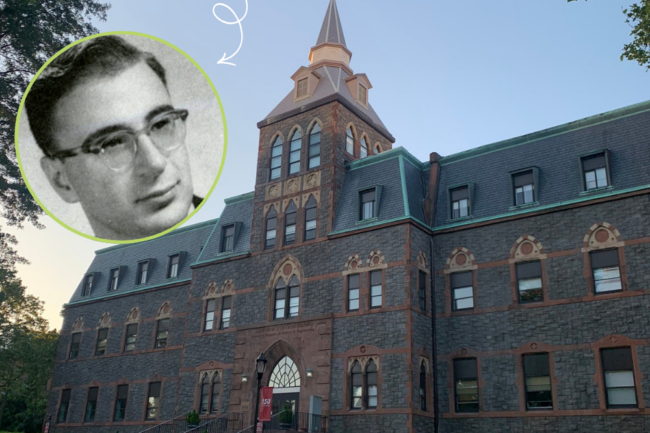
David J. Farber was born in Jersey City on April 17, 1934, long before anyone could possibly imagine the creation of a global network that would eventually link billions of people in an instant. His childhood was not one of great privilege or particularly notable, aside from his burgeoning geekiness. He credited his father for encouraging him to tinker with electronics and build radio set kits that he found wandering around Manhattan as a little kid. The Hayden Planetarium was his happy place. As a teen, he analyzed an author with Boolean algebraic logic for a literature term paper assignment. He had started high school in Jersey City, but graduated from the public high school in Lodi.
Read More: 9 Apps and Websites Created by Hoboken + Jersey City Residents
During his last two years of high school, David worked weekends at a grocery store, which earned him enough for one year of college, but he was later relieved that “once I was admitted to college, my aunt offered to help with my tuition because I was the first kid in our family to get into college.” He then attended Hoboken’s Stevens Institute of Technology, where his top-nerd credentials were solidified.
Top Thinker
Undergraduate David made the dean’s list, joined the chess, camera, and engineering clubs, received honors, and built personal relationships that would change our everything. He completed an undergraduate degree in electrical engineering in 1956, then earned a graduate degree in mathematics in 1961. By the time he left Stevens, he had already begun to develop himself into a conduit for ideas between great thinkers.


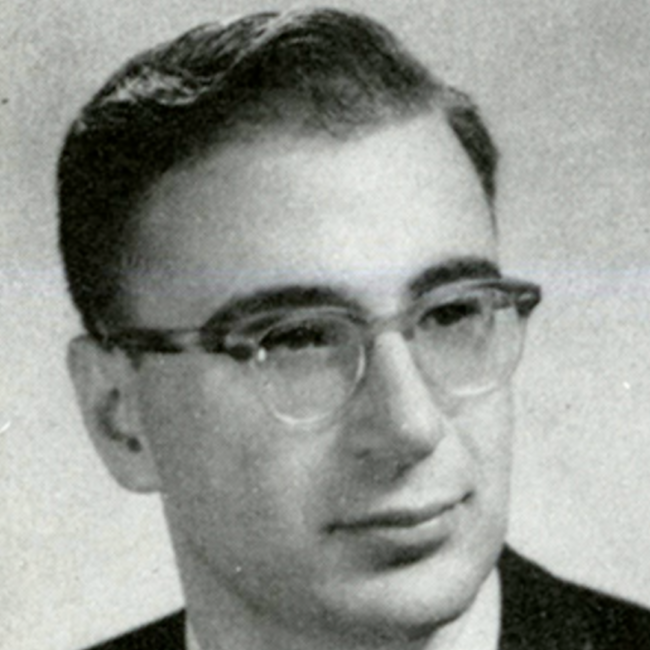
Photo Credit: S.C. Williams Library at Stevens Institute of Technology, Archives & Special Collections, Hoboken NJ

David once credited Stevens Institute’s Detrich Wally as a pivotal influence in his development. Detrich Wally worked on an early transistorized analog computer. The lab where the two worked was one of the few rooms on campus with air conditioning, installed specially to keep transistors from overheating. Detrich and David spent hours talking through David’s fascination with the “possibilities of computing.” Those conversations shifted his interests from general engineering toward the very specialized world of computer architecture, where he would excel.
We are All Connected because He Knew How to Connect
In later years, David spoke highly of several Stevens faculty he encountered while there, noting that they taught “many things outside of electrical engineering.” He specifically recalled his professors as “superb” for teaching complex theory through practical application. The hands-on Stevens philosophy, in which students had to build the things that they designed, became a hallmark of his later work, such as the construction of CSNET and token ring networks.
David believed that moving into a fraternity house on campus had a positive impact on him socially. He said that he learned, there, how to live and collaborate with a diverse group of people in a way that proved vital later in his career when he became a bridge-builder between academia, the government (FCC), and private industry. He was never just a coder or a computer engineer. He was also a master networker between people who built the digital network so vital to our lives today.
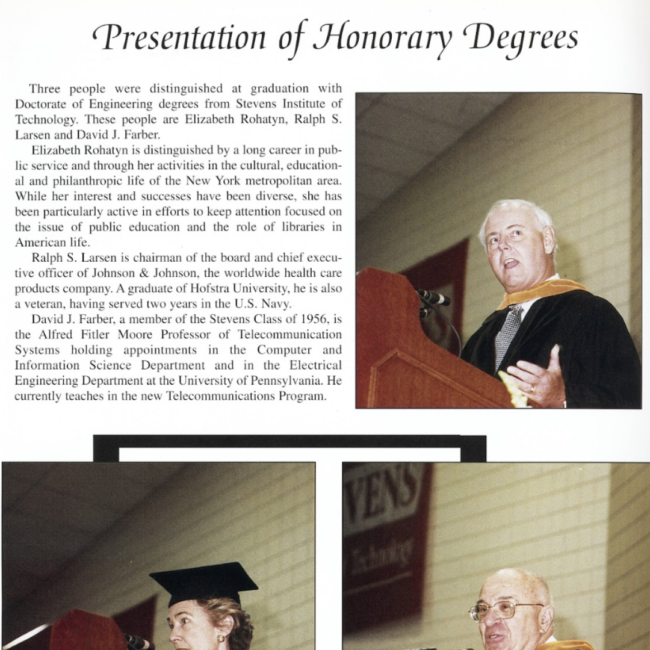
Photo Credit: S.C. Williams Library at Stevens Institute of Technology, Archives & Special Collections, Hoboken NJ
During his final year at Stevens (around 1955-1956), David and his classmates built a prototype for a digital computer as their senior thesis. He referred to this project as his formal introduction to digital computing and said that the team-building and collective problem-solving required for the project mirrored the collaborative research environments he would later lead at UC Irvine and the University of Delaware.
Throughout his epic career, David became widely known as an excellent mentor. His global list of contacts in the tech field connected brilliant minds with the most difficult tasks. He was given his nickname because he mentored Jon Postel, David Mockapetris, Vint Cerf, and Bob Kahn — all of whom are considered ‘fathers of the internet.’ The list of internet architects who attribute their careers, in part, to David J Farber is incredibly long and becomes exponential as the connections branch outward.
What Was Once a Series of Tubes
When David began his career, computers were rooms full of vacuum tubes. After graduating from Stevens in 1956, he worked for 11 years at Bell Laboratories, where he helped design the first electronic switching system (ESS-1) and the SNOBOL programming languages. He went on from there to help create several important research networks — CSNET, NSFNet, NREN and the Gigabit Network Testbed Initiative.
He then held industry positions at the Rand Corporation and Scientific Data Systems and worked within academic positions at the University of California, Irvine, the University of Delaware, Carnegie Mellon University, the Wharton School of Business at UPenn and, at the time of his death, was a distinguished professor and co-director of the Cyber Civilization Research Center at Keio University in Japan.
Today, David’s hometown of Jersey City is seen as a premier “Wall Street West” tech hub, regularly ranked a US top tech city by Cloudwards. Hudson County, generally, with Hoboken and Jersey City at the fore, is a critical extension of New York City’s financial technology (Fintech), and a hub for AI, and for cybersecurity firms. Our NJ home is a prominent startup location, boasting a high density of women-led tech firms. But none of that was true when Farber was coming up around here, because, well, he and his peers had not yet invented any of the technology that would facilitate our current state of human civilization. Under his watch, and very much through his leadership, tech changed the world.
A Voice of Concern and Advocate for Strong Policy
It is worth noting, and important to the man’s legacy, that David spoke out regularly about dangers and concerns related to the internet. He was especially worried about privacy, surveillance, and civil liberties, and raised specific concerns about Google Glass and wearable surveillance. Always a big-picture thinker, he was adamant that ethical considerations be a part of all tech projects. As a famous alum, he actively supported programs to promote inquiry & ethics for Stevens students.
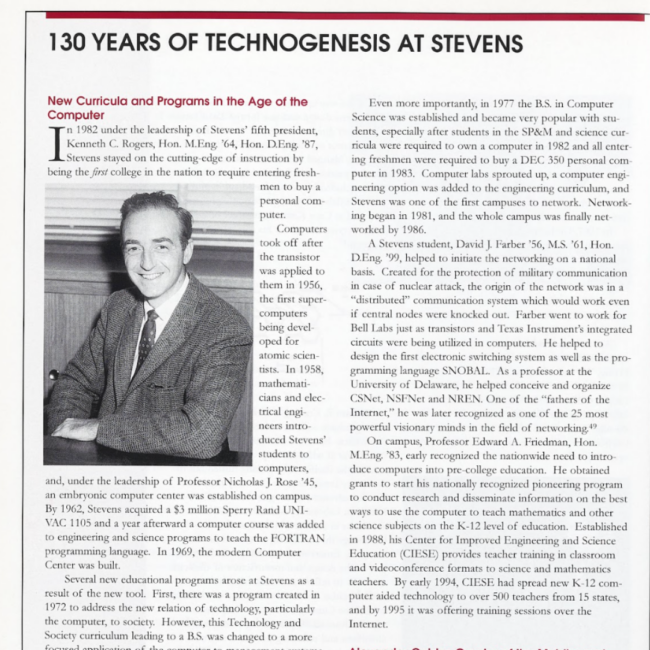
Photo Credit: S.C. Williams Library at Stevens Institute of Technology, Archives & Special Collections, Hoboken NJ
In his later years, he warned those in power consistently that our rights and liberties must be protected from the dangerous overreach of tech companies and their products. Even when booed and heckled, he did his best to sound the alarm that individuals’ privacy and our basic freedoms are in need of protections from the very technologies that he helped to build.
See More: Who Owns Ellis Island? Revisiting the 1998 Case Between NJ + NY
David’s most profound contribution may be the moral clarity he maintained as our current reality took shape. By spending his final years as a vocal sentry, warning us to protect our privacy and civil liberties with the same ingenuity he used to build the network itself, Farber left behind a challenge for the next generation. His voice of caution belies the fact that to be a true architect of the future, one must not only possess the technical skill to build the world but the courage to stand up and defend the humanity within it. This Local Girl can’t help but wonder if the internet would possibly be a less dangerous place if more grandmothers and mothers had been involved in its developmental stages.
Follow @thehobokengirl on Instagram + TikTok for the latest Hoboken and Jersey City updates, sign up for our weekly newsletter here that shares everything you missed each week, and check out our events calendar, which has over 100+ events weekly to peruse.