Lauren Rivera
In March 2024, New Jersey passed a law requiring landlords and property sellers to disclose any flood risks upfront. As most longtime residents know, Hoboken + Jersey City are considered high-risk flooding zones. Read on for the details of New Jersey’s flood disclosure mandate and how it impacts buyers, renters, insurance, and transparency in real estate.
About the Flood Disclosure Mandate
On September 29th, 2022, Bill S3110/A4783, which requires landlords and property sellers to disclose any known flooding risks to potential buyers and tenants, was introduced in the New Jersey Legislature. NJ Governor Phil Murphy signed the bill into law on June 3rd, 2023, and it officially went into effect on March 20th, 2024.
Read More: New Jersey State Assembly Passes New Mansion Tax Law: What This Means
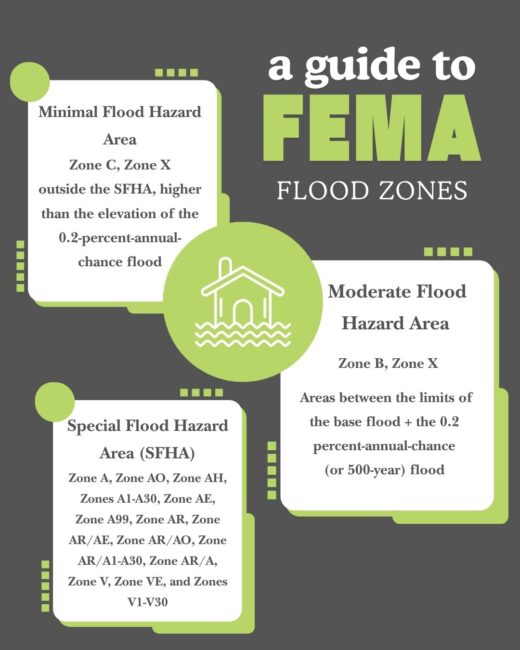
This means that, as of March 2024, property sellers and landlords must disclose to prospective buyers and tenants, prior to lease signing + renewal, or closing on a home, any known history of flooding or risk. It must also be disclosed whether or not the property is located within a FEMA Special or Moderate Risk Flood Hazard Area.
According to FEMA, the Special Flood Hazard Area (SFHA), also referred to as “the base flood” or “100-year flood,” is a high-risk flooding area that has a one-in-100 chance of flooding significantly each year. Similarly, the Moderate Risk Flood Hazard Area, also known as “500-year-flood,” has a .2% chance or one-in-500 chance of experiencing significant flooding each year.


“For far too long, countless New Jerseyans have lacked the critical information they not only need, but deserve, to make smart, forward-looking decisions for their properties and families,” Governor Murphy said in a statement in 2023. “In the aftermath of Tropical Storm Ida – and as flooding events continue to increase in frequency and severity – these requirements will help better prepare New Jersey homeowners and renters for extreme storms.”
For over a year, the Garden State and 35 other states have operated under a flood disclosure law, per FEMA.

Jill Biggs, CEO of the Jill Biggs Group at Coldwell Banker Realty, located at 323 Washington Street, Hoboken, says that this law has “forced a higher standard” in the local real estate industry.
“Before, disclosures were often vague or entirely dependent on a seller’s memory or willingness. Now, we’re required to be more diligent and more specific. The law has raised the bar across the board, and in my opinion, it was overdue,” she said.
Which Hoboken + Jersey City Zones are Within a Flood Hazard Area?
FEMA’s Flood Risk Notification Tool categorizes a municipality into three different flood zone designations: Minimal Flood Hazard Area (low-risk), Moderate Flood Hazard Area (moderate-risk), and Special Flood Hazard Area (SFHA). These determine the likelihood of flooding in each area and whether flood insurance is required for the property.
The map itself is shaded differently, depending on the flooding severity. Blue shaded areas represent Zone AE, which are high-risk zones that have a 1% annual chance of flooding. Properties in these areas are typically required to have flood insurance if they’re under a federally backed mortgage. Orange and yellow shaded zones represent Zone X, meaning there is usually minimal flooding experienced. Unshaded areas in grey are spots that do not fall under a FEMA flood risk zone.
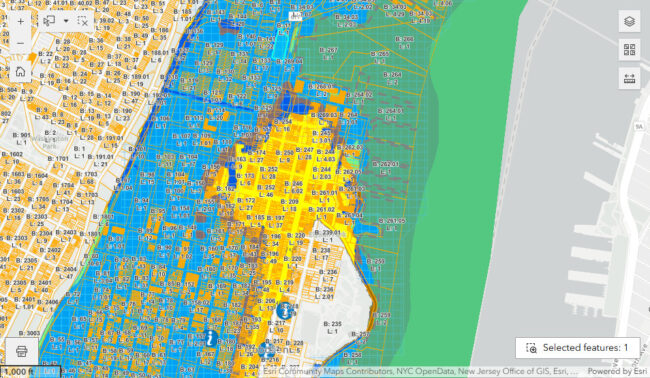
Photo Credit: FEMA’s Flood Risk Notification Tool ^ northern area of Hoboken
As seen in FEMA’s map, a large majority of Hoboken, including the entirety of the coastline, is shaded blue, meaning it falls under a high-risk zone for flooding. Almost all of the western half of the Mile Square is also blue, with a few pockets of orange.
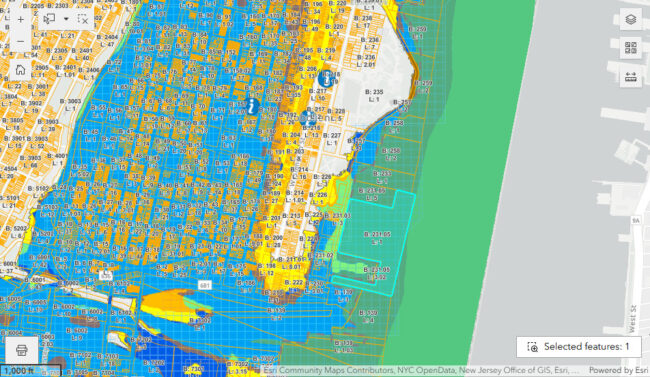
Photo Credit: FEMA’s Flood Risk Notification Tool ^ southern area of Hoboken
Over in Jersey City, a good portion of the neighborhoods are also shaded blue, with a handful of spots shaded yellow and orange. There are even some areas, like Liberty State Park, where the entire site falls under a high-risk zone.
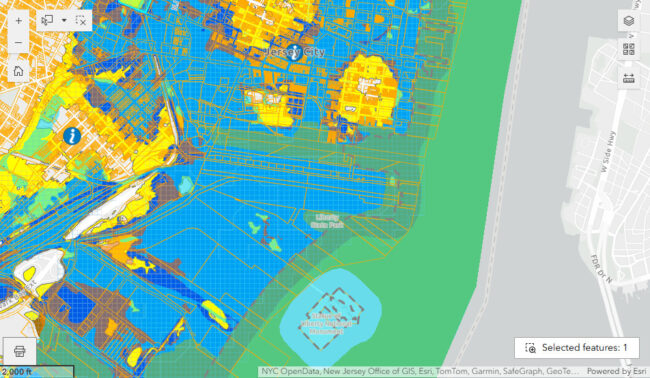
Photo Credit: FEMA’s Flood Risk Notification Tool ^ Liberty State Park
Flood Factor, another flood mapping tool, claims that approximately 21,530 properties in Jersey City are at risk of flooding over the next 30 years, which represents 39.1% of all properties in the city. This can be visually seen in FEMA’s map, where a good portion of JC neighborhoods are also shaded blue. Only a handful of spots are shaded yellow and orange, and there are even some areas, like Liberty State Park, where the entire site falls under a high-risk zone.
Check to see where your property falls on FEMA’s flood risk map here.
What the Law Means for Renters
At the time of application and before signing a lease, tenants should receive a form from the landlord titled Flood Risk Notice. This is a statewide form, created by the NJ Department of Community Affairs, that provides concrete answers to various questions surrounding flooding.
Suppose a landlord does not disclose any flood risks and a tenant later experiences “substantial” damage to their property as a result of flooding, with “substantial” specifically meaning a repair or replacement cost that is 50% or more of the property’s current market value at the time of the flooding. In that case, the tenant is allowed to terminate their lease via a written 30-day notice. This notice is only applicable within 30 days of the flooding.
The landlord also has 30 days to refund any rent paid in advance, and tenants are allowed to legally pursue the situation further, according to the law.
What This Means for Buyers
Jill explains that flood risks are no longer a “post-offer surprise.” Instead, they’re now “baked” into the real estate checklist. Part of that includes the Seller’s Property Condition Disclosure Statement, a standardized form created by the NJ Division of Consumer Affairs that includes answers to questions like whether there are any flooding risks, whether the property requires flood insurance, and more.
According to the law, if the property seller answers yes to any of the questions listed, they are required to provide a detailed explanation of the situation.
What to Know About Insurance
The standard renters’ and homeowners’ insurance typically covers situations like fires, thefts, and smoke damage, but it does not typically cover flood damage, per the law.
All renters and property owners, including business owners, can receive flood insurance through the National Flood Insurance Program (NFIP), a federal program managed by FEMA. Under this insurance program, renters can purchase a contents coverage policy, which protects personal belongings, including everything from furniture to curtains to original artwork.
Along with the contents coverage policy, buyers can purchase a building coverage policy, which covers electrical + plumbing systems, furnaces + water heaters, refrigerators, stoves, built-in appliances, carpeting, and more. For homeowners, “building policies cover up to $250,000 of flood damage, and content policies cover up to $100,000 of flood damage,” according to the website.
Depending on the property, where it’s located on FEMA’s flood risk map, and the terms of a lease or mortgage, flood insurance may be required. NFIP policies also typically include a 30-day waiting period before they take effect.
Buyers should also be aware that if a property they’re interested in has previously received federal disaster assistance, they are required to obtain flood insurance. “Failure to obtain and maintain flood insurance can result in an individual being ineligible for future assistance,” the law states.
Renters’ Insurance Things to Note
For renters specifically, all leases are also legally required to include this statement from the NJ Department of Community Affairs:
“Flood insurance is available to renters through FEMA’s National Flood Insurance Program to cover your personal property and contents in the event of a flood. A standard renter’s insurance policy does not typically cover flood damage. You are encouraged to examine your policy to determine whether you are covered.”
See FEMA’s NFIP website for more.
Resources for All
- Know your rights + read about New Jersey’s flood disclosure mandate law
- Locate your property on FEMA’s Flood Risk Notification Tool
- Renters: check out the official Flood Risk Notice form
- Buyers: check out the official Seller’s Property Condition Disclosure Statement
- Learn about the National Flood Insurance Program (NFIP)
- A list of flooding resources in Hoboken
“Don’t let flood risk scare you into paralysis,” Jill said. “What matters is that you understand the risk, the costs, and how to mitigate both. Armed with the right information and the right strategy, flood disclosure becomes just one part of the broader due diligence process — not a dealbreaker.”
See More: What to Do if Your Home Floods in Montclair + Beyond
Follow @thehobokengirl on Instagram + TikTok for the latest Hoboken and Jersey City updates, sign up for our weekly newsletter here that shares everything you missed each week, and check out our events calendar, which has over 100+ events weekly to peruse.